
Table of Contents
Time Management: The Cornerstone of Success
Effective time management is more than just organizing tasks. It’s a powerful skill that transforms your daily productivity and overall well-being. Mastering this discipline helps you achieve more with less stress.
It empowers you to take control of your schedule, not simply react to demands. This proactive approach ensures your energy and focus are directed towards what truly matters. It’s an indispensable asset for personal and professional growth.

The True Cost of Poor Time Management
Neglecting time management carries significant consequences. It often leads to a cycle of missed deadlines and increased anxiety. This can severely impact both your output and your mental health.
Poor management drains your energy and diminishes your sense of accomplishment. It creates a feeling of being constantly overwhelmed and behind. Understanding these costs highlights the urgent need for better strategies.
- Increased stress and burnout symptoms.
- Missed opportunities for growth and learning.
- Lower quality of work and decreased productivity.
- Damaged professional reputation.
- Reduced personal time and work-life imbalance.
- Constant feeling of being overwhelmed.
Mastering Time Management: Actionable Strategies
Improving your time management begins with adopting practical, repeatable techniques. These strategies offer structured ways to approach your daily tasks. They help you reclaim control over your hours and minutes.
Each method focuses on different aspects of productivity and prioritization. Experimenting with these approaches will help you find what works best. The goal is to build sustainable habits that enhance your effectiveness.
1.The Eisenhower Matrix: Prioritize with Precision
The Eisenhower Matrix is a robust time management tool for prioritizing tasks. It categorizes actions based on their urgency and importance. This clear framework helps you decide where to focus your efforts.
Dividing tasks into four quadrants simplifies decision-making. You can quickly identify what needs immediate attention. It also clarifies what can be delegated, scheduled, or eliminated entirely.
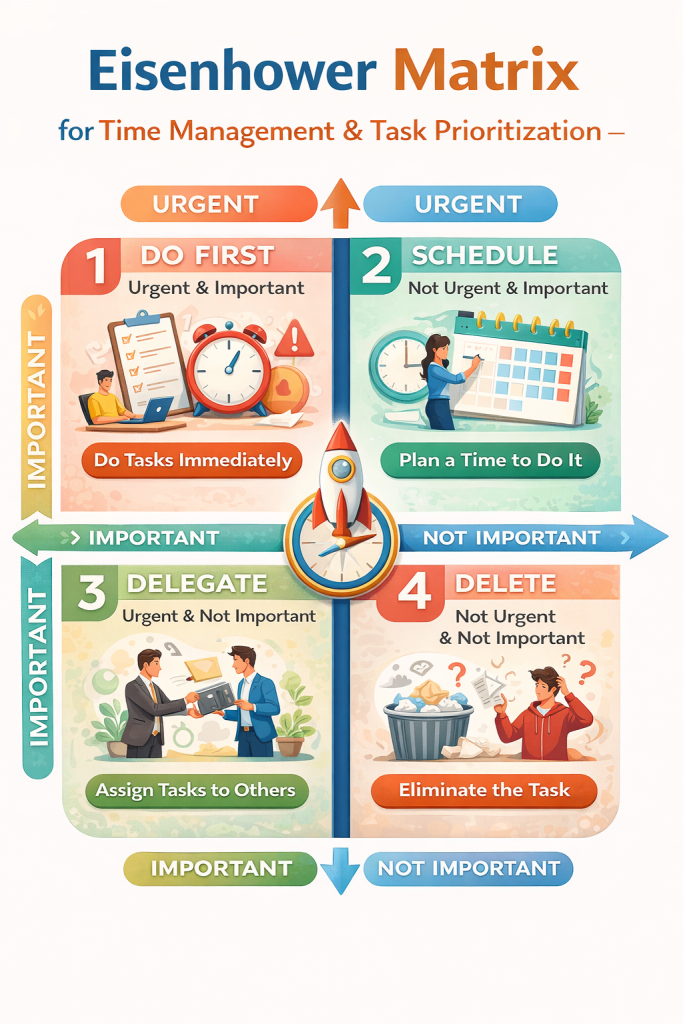
- Urgent & Important: Do first (Crises, deadlines).
- Important, Not Urgent: Schedule (Planning, relationship building).
- Urgent, Not Important: Delegate (Some emails, interruptions).
- Not Urgent, Not Important: Eliminate (Time wasters).
2. The Pomodoro Technique: Focused Bursts
The Pomodoro Technique uses a timer to break down work into focused intervals. Typically, these are 25-minute periods, known as ‘Pomodoros,’ followed by short breaks. This method enhances concentration and prevents burnout.
It trains your brain to stay focused for short, intense bursts. The regular breaks help maintain mental agility and reduce fatigue. This simple yet effective approach is excellent for deep work sessions.
- Choose a task to focus on.
- Set a timer for 25 minutes.
- Work on the task until the timer rings.
- Take a short 5-minute break.
- After four Pomodoros, take a longer 15-30 minute break.
3. Time Blocking: Schedule Your Success
Time blocking involves allocating specific blocks of time to specific tasks. You literally schedule every minute of your workday. This includes work, breaks, and even personal activities.
It creates a detailed roadmap for your day, minimizing distractions and procrastination. By pre-committing to tasks, you ensure important work gets done. It’s a powerful way to visualize and control your schedule.
4. The Two-Minute Rule: Tackle Small Tasks Instantly
The Two-Minute Rule is incredibly simple yet highly effective. If a task takes less than two minutes to complete, do it immediately. Don’t defer it, add it to a list, or overthink it.
This rule helps clear small nagging tasks that often accumulate. It prevents mental clutter and builds momentum. Applying this rule regularly saves significant time in the long run.
5. Learn to Say No: Protect Your Time
Saying ‘no’ politely but firmly is a critical time management skill. Overcommitment is a common pitfall that stretches you too thin. Protecting your schedule means setting clear boundaries.
Declining non-essential requests allows you to focus on your priorities. It prevents your calendar from becoming overrun with other people’s needs. This assertive approach ensures you retain control of your valuable time.
6. Batch Similar Tasks: Optimize Flow
Batching involves grouping similar tasks together and completing them all at once. For example, answer all emails at a specific time or make all phone calls consecutively. This minimizes context switching, a major time-waster.
By reducing the mental effort to shift between different types of work, you boost efficiency. This strategy creates a focused flow, allowing for deeper concentration. It’s especially effective for routine administrative duties.
7.Digital Detox: Minimize Distractions
A digital detox means intentionally reducing your engagement with digital devices and notifications. Constant pings and alerts fragment your attention. They make sustained focus almost impossible.
Designating specific periods for unplugging allows for deep work and mental clarity. It helps you reclaim control over your attention span. This intentional break improves concentration and overall well-being.
Choosing the Right Time Management Tools
The right tools can significantly enhance your time management efforts. From digital apps to physical planners, options abound. Selecting wisely depends on your personal work style and specific needs.
Consider features like task prioritization, scheduling, and progress tracking. The best tool is one you will consistently use. It should integrate seamlessly into your existing workflow.
| Method/Tool | Pros | Cons | Best For |
| Eisenhower Matrix | Clear prioritization, reduces procrastination | Requires consistent evaluation, not a task manager | Strategic decision-makers, project managers |
| Pomodoro Technique | Boosts focus, reduces burnout, prevents multitasking | May be disruptive for collaborative tasks, fixed intervals | Deep work, studying, creative tasks |
| Time Blocking | Comprehensive schedule control, prevents overcommitment | Rigid, unexpected interruptions can derail schedule | Highly structured individuals, busy professionals |
| Trello/Asana | Visual task boards, collaboration features, progress tracking | Can become overwhelming with too many boards, learning curve | Teams, complex projects, visual thinkers |
Integrating Time Management into Your Daily Life
Successful time management isn’t a one-time fix; it’s a continuous practice. Start small with one or two strategies that resonate with you. Consistency is far more important than perfection in the beginning.
Regularly review your progress and adapt your methods as needed. Your approach to time management should evolve with your responsibilities. Embrace experimentation and adjust to find what truly empowers your productivity. Discover effective Goal Setting strategies. For more insights on improving productivity, refer to Harvard Business Review on Time Management.
Overcoming Common Time Management Challenges
Even with the best intentions, challenges to effective time management will arise. Procrastination and perfectionism are common hurdles. Unexpected interruptions can also derail your meticulously planned day.
Developing resilience and flexible strategies is key to navigating these obstacles. Understanding the root cause of these challenges helps in addressing them effectively. It’s about building a robust system that can withstand daily pressures.
- Procrastination: Break tasks into smaller, manageable steps. Focus on starting, not finishing.
- Perfectionism: Set realistic expectations. Understand that done is often better than perfect.
- Interruptions: Allocate specific ‘do not disturb’ times. Communicate boundaries to colleagues and family.
- Multitasking: Resist the urge to do many things at once. Focus on single-tasking for better results.
Explore top Productivity Tools for enhanced focus. For further reading on skills, check out Forbes Advisor on Time Management Skills.
The Future of Your Productivity: Start Now
The journey to superior time management starts today. Implementing these proven strategies will transform your efficiency and well-being. You’ll not only achieve more but also experience greater calm.
Embrace the power of focused work, smart prioritization, and intentional breaks. Your future self will thank you for taking control of your most valuable asset: your time. Start applying these principles and unlock your peak productivity now!